Sunday, March 16, 2014

TOW 21 - Lip Sync Battles (Jimmy Fallon)

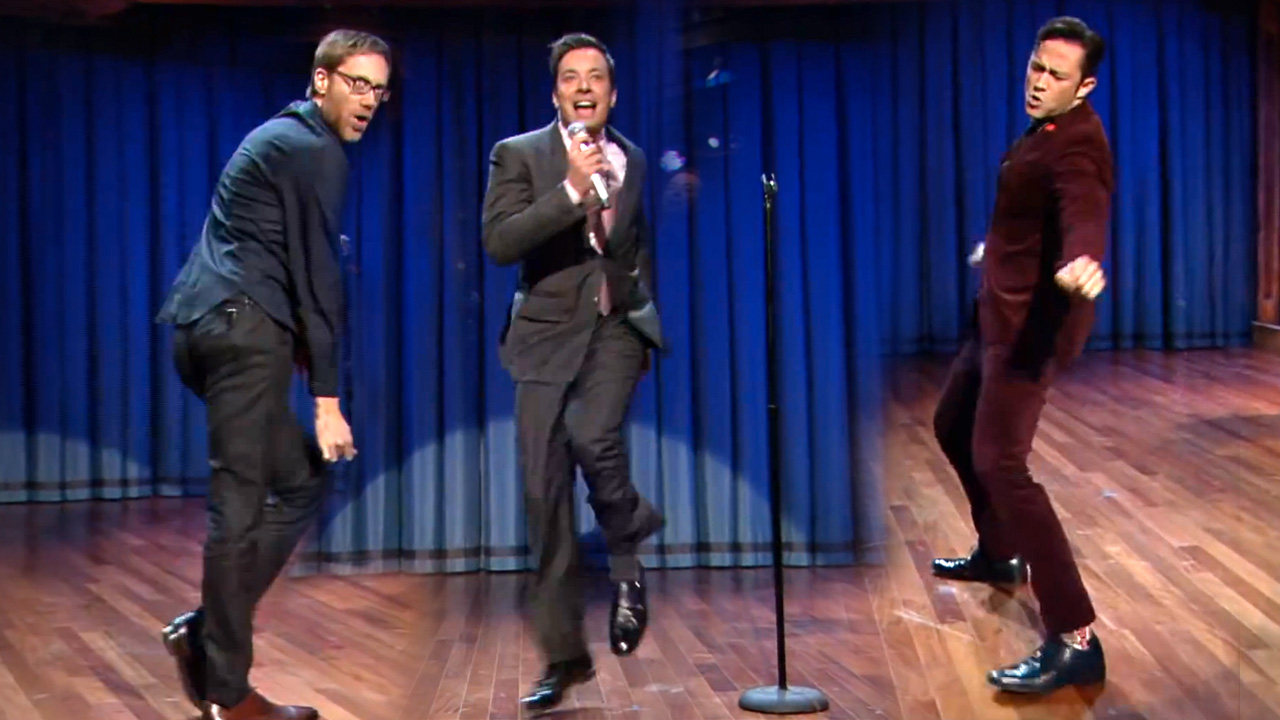
When you’re asked what you do for fun, you realize that the ways we entertain ourselves are so strange. Humor is the most entertaining way to take your mind of real world issues and complications, and while it may seem trivial, it can be critical to maintaining our mental health. One way I regulate my cerebral well-being is by watching Jimmy Fallon Lip Syncing Battles. In the lip sync battle with Joseph Gordon Levitt and Stephen Merchant, Jimmy Fallon and his guests use stylistic choices and serious tones to give their viewers a break from reality with entertainment. 
The way you define stylistic choices in writing is not be entirely the same as what you would call it in video, but nevertheless it is still effective. In this case, the three comedians choice of songs says a lot about their goal for the viewer. The songs chosen were tremendously popular at some point within the past thirty years, targeting a wide audience that will immediately connect with and enjoy the show. As they go onto lip sync, they are rousing nostalgia within the audience while poking fun at what we used to enjoy in a lighthearted fashion. With every inevitable laugh provoked, as heard in the studio audience, there is proof that these three are doing their job of entertaining.
These humorists use a mockingly serious tone which makes their work even more sidesplittingly hilarious. The fact that they chose their songs, they knew how ridiculous they would seem performing them, and they treated it as if they were serious musicians makes the performances infinitely better. How they perform their songs is almost ironic: seeing a tall, lanky man like Stephen Merchant swinging his hips to a fierce song by BeyoncĂ© seems like the epitome of unexpected. Almost startling, the commitment Merchant displays is so unanticipated that it adds to the performance’s humor overall.

A person’s sense of humor is specific to him or her as an individual, but judging by the studio audience’s reaction, I can’t be the only person to crack up. Humor is the perfect way to fix a bad day or forget your problems, and in this sense entertainment is the best form of procrastination.
Saturday, March 1, 2014

TOW 20 - Anti-Smoking Advertisement (CONAC)

Ever since elementary school, the perversion of smoking has been emphasized. Through tragic retellings by loved ones, or with the school nurse’s plastic model of a smoker’s lung immersed in sludge, children are taught that smoking is neither pretty nor cool. Why does no one teach the adults that? In its 2013 advertisement promoting awareness towards smoking, the Chilean Corporation Against Cancer (CONAC) uses children’s innocence to take a stand against adult's recklessness. Through commanding imagery and succinct sentence structure, CONAC's advertisement forces smoking adults to realize the universal effect of their actions. 
The suffocating bag of smoke, the child’s empty wail, the nothingness of the background – everything about this image demands attention. The striking anguish on the child’s face causes even a cursory glance to induce shock and heartache. After further investigation, what seems to be a plastic bag killing the child, a common method of suicide, is actually a shroud of smoke engulfing his head. The suicide by suffocation contrasts the portrayed innocence of this child to show that this boy did not have a choice. The image emphasizes the effect of smoking, specifically secondhand smoke, is more pervasive and impacts not just the smoker.
There are two simple sentences in this advertisement, but it is guaranteed that they will stick with you: “Smoking isn’t just suicide. It’s murder.” CONAC could have gone on about the harmful side affects of smoking, but they didn’t.  They didn't use the more formal “it is,” but rather they chose a contraction. The structure adds a dramatic intensity that creates mixed emotions in the reader, such as distress, remorse, angst and shame.  By keeping the message short and not necessarily sweet, CONAC gets its message across and packs a punch. The impact of smoking slowly sinks into the reader – the few words in the sentences, like suicide and murder, have a powerful ripple effect of resonation.
Smoking has always been off limits like the cookie jar teetering on the top shelf that’s just too high to reach. CONAC’s advertisement transforms that cookie into the glob of artificial sugar and bulging fat that it is.


Sunday, February 23, 2014

TOW 19 - Love and Limerence – the Experience of Being in Love (Dorothy Tennov)

Love has always been simple. Not when you’re in love, because then it’s messy and complicated, but when you are an objective observer, noticing a couple quixotically gazing into each other eyes, you can just know that’s love. Of course there are different types of love, the type you feel for your family, for your friends, for your partner, for your dog, and so on, but either way it’s simple. Dorothy Tennov’s book, Love and Limerence – the Experience of Being in Love, enlightens us with the information that sometimes your love isn’t real. In the first half of the book, Tennov uses personal anecdotes, scientific research and personification to explain the difference between love and limerence.
Tennov opens her text with a dialogue between a student and herself discussing the student’s breakup. Tennov realizes that everyone had a heartbreaking love story comprised of the same general events. Through the use of her own anecdotes, Tennov is able to establish a pattern in not only her study, but also the reader’s mind. The reader can acknowledge that this pattern is based off real life and not a closed-system science experiment.
To add credibility to her theory, Tennov references renowned experts in the study of love. A reference such as Sigmund Freud, a well-known researcher for his eccentric theories on sexuality, or Eric Fromm, a scientific name less common than Freud but more recent, shows the audience that Tennov’s theory is not so out-there. Using other’s theories for support, is a common form of induction that appeals to logic as well.
A personal favorite of Tennov’s techniques is her use of personification. Tennov describes limerence almost as a person. For example, “Limerence enters your life pleasantly. It may be an old friend… Or it may be a new person.” This device makes it easier for the reader to visualize and relate to an elusive idea.
So far, Tennov has successfully explained a complex idea to the simple-minded in a way that causes you to question relationships. It enters your mind that all of what you have seen or all of what you have felt may not have been love.


Tuesday, February 11, 2014

TOW 18 - Keep the Door Open (Charlemagne)

Current events are history in the making; they reflect cultural values and defining events. The Economist is valued for its factual and refreshing perspective on modern world issues. In his blog post featured in The Economist, the faceless Charlemagne uses esoteric references and a specific arrangement to suggest that the Ukraine would be smart to rejoin the European Union. For someone who is not well versed on current events, someone who is not informed of the current turmoil in the Ukraine, reading Charlemagne's article at first is a bit of a challenge, but for those who are up to date they can fully understand and appreciate the article's insight. Lack of a summary of the crisis can be seen as reckless on Charlemagne's part, however in this context he targets an audience of educated and informed citizens. The readers can acknowledge and appreciate that the author is specifically talking to them, creating a sense of flattery, and thus makes the message more likely to resonate. Since the reader is already aware of the basic background behind the situation, he or she is more likely to be open to the different interpretations of the event. Charlemagne slips in the different perspectives surrounding the situation, exposing the reader to different views, and then ends his text with what he believes to be the best possible solution, his own. This arrangement resembles a concert: the opening act followed by what you've been waiting for. Charlemagne warms up his audience with others' solutions, which he does not believe to be appropriate, and then finishes with what he believes to be the proper solution. Charlemagne leaves the reader with something to think about, by ending with his own solution there is less guess-work to what the reader will be considering.

http://www.economist.com/news/europe/21595957-how-europe-nearly-lost-ukrainebut-may-yet-regain-it-keep-door-open


Sunday, February 2, 2014

TOW 17 - The Sociology of Gossip (Elaine Lui)

Gossip is shameful. The perspective of this generation is that talking about other people is embarrassing and indecent; it is better to deny the act of talking behind someone's back than to admit a universal activity. Gossip is a commonality not only between modern society, but Elaine Lui provides research that shows it is also an age-old practice dating back to the ancient Egyptians. "Lainey" runs an online gossip site called laineygossip.com where she discusses the hot topics that are gracing the covers of magazines like PeopleUs Weekly, etc. In February 2013, Lui spoke at TEDxVancouver reminiscing on milestones of pop culture in 2012 while analyzing the deeper impact of these events and the ripple effect of gossip they caused. Lui uses metaphors, allusions and rhetorical questions, in her TED Talk to argue that gossip is an ancient convention that provides academic insight into a culture's current values and ultimate fate. TED is an organization that features some of this generation's greatest scientific and philosophical minds. Making an appeal to pathos by stating she is not as "distinguished" as some of the other speakers, Lui acknowledges this context and takes advantage; since her audience is educated enough to understand the words of sociologists and marine biologists, Lui compares today's social culture to that of an ecosystem. The different organisms in an ecosystem have different roles, all interdependent on at least one of the other organisms. Lui's anticipation of an educated audience allowed her to make appropriate comparisons that elevate the complexity of gossip. The audience has also not been living under a rock, and Lui knows this. Kristen Stewart's infidelity, Chris Brown's violence, John Travolta's supposed affairs, all of these events were popular in 2012 and all of these events were referred to in Lui's speech. Not only do these allusions show that Lui is a well-informed reporter, but also that there is a pattern among what is glorified in society. Lui constantly asks her audience to reflect on that. She uses rhetorical questions to force the audience's realization of what they value emphasizing"marital convention, fidelity, feminist regression or progression, social violence, and sexual orientation." These questions don't speak to the character of Kristen Stewart, Chris Brown, or John Travolta, but rather of the audience. The audience is the one craving these stories that gossip provides; so is really the act of gossip that's shameful? Or the values of the people who gossip?

http://www.youtube.com/watch?v=oFDWOXV6iEM

Saturday, February 1, 2014

IRB Intro Post: MP 3

Love is an undefined phenomena; as a society we don't know whether to call it an attitude, an emotion, or a style of living. Dorothy Tennov delves into the psychological condition of being in love in her book, Love and Limerence – the Experience of Being in Love. A friend read Tennov's text for a summer class at Emory University, and as time went on she raged more and more and the insights of the book. I've always loved psychology; I find it fascinating. I had never really thought about the psychological aspect of love, to me it was just a thing that happened. As I learn more about the biological signals in school, the idea of love being a scientific phenomena seems more and more possible.

Tuesday, January 21, 2014

TOW 16 - Frida Kahlo (Gannit Ankori) pt. 2

Gannit Akori did not end his story with a happy reader. I could tolerate the information overload for the first half of the book but by the end it seemed it was simply that. While Akori's appeal to logic is effective immediately, excess overwhelms the reader and seems trivial. In a way, it seems as if Akori didn't employ any of his own writing style in his book; it is more like a compilation of paraphrased citations. Kahlo has an emotional backstory but that is lost in how Akori translates it. By trying to remain objective, Akori does appear to be factual, but he comes across as detached and loses the reader's enthusiasm in the process. Looking back on my past critique, TOW 12, it occurs to me that what I described as "passion towards Frida Kahlo’s life story" illustrating "Kahlo's desire to thrive" was based not on Akori's writing, but his content. Kahlo was an inspirational women whose struggle and success created art that has moved and continues to move millions. Akori failed to capture an appetite for life that was so evident and essential in Kahlo's life; he was able to describe it yes, but it would have been much more effective to use vivd imagery and passionate diction. Akori seemed to spew facts at the reader that have no way of connecting with the reader. Anyone can connect with feeling alone, unworthy, or unsuccessful, just like Kahlo. Akori should have played off of those emotions and portrayed Kahlo as more of a realistic person, rather than a prominent figure in art and culture. I was disappointed with the book in totality but there were definitely shining moments; however I cannot say that those moments show the skill of Akori as a writer more than the skill of Kahlo as a person.