Sunday, April 27, 2014

TOW 25 - Walk the Moon performance @ iTunes Festival

Popularity is an abstract concept. Each has his or her own perception of allure and attraction, but what grants someone national appeal? A single person or a group of people is able to gain the love and affection of thousands of people, despite each person having a different perspective on perfection. Musicians are able to pull at the hearts of millions not only across a country but also across the seas. It would be naïve to say their popularity is solely based on their music. It is live performances that create the magnetism of international stardom; it is these that allow small town bands from Ohio to create a far-reaching impact. Walk the Moon’s iTunes Festival performance demonstrates the persuasive forces of appearance, energy, and interaction, the basis of what distinguishes memorable musicians.
            The appearance of Walk the Moon is representative of their music, automatically informing its listeners of its purpose. The painted streaks of purple and white lining each member’s face set the band into a unique genre – automatically the audience realizes the band intends for this concert experience to be a fun one. Paint is associated with creativity and imagination, two qualities that can definitely create a good show.
            A show should be energetic and lively; when a band presents those traits in its performance, it heightens the overall experience. The concerts that feel on the brink, the atmosphere practically ready to burst – those are the shows to remember. Walk the Moon is constantly jumping up and down, dancing around the stage, making a fool of themselves, in order to encourage the audience to do the same. It is essentially this spirit that spreads throughout the audience, and it is that spirit that spreads the audience to an international level.
            When a band interacts with its audience it creates a connection between the two, a feeling that is coveted by most. When Walk the Moon talks to its audience, encourages them to dance, they are creating a more intimate atmosphere; even though the audience consists of thousands of people, the band is interacting to them as a whole. That ability of performance is not only impressive, but also coveted.

            Walk the Moon was not known by many in London until the iTunes festival. They were not known in this area until the Made in America festival of 2013. Performances are what spurred its fame. While in a perfect world it would be the artistry that generated fame; in reality it is the band’s poise and how the portray themselves that does it.


http://irocktheshot.com/wp-content/uploads/2012/07/walk-the-moon-at-firefly-festival-papeo-281.jpg


Wednesday, April 23, 2014

TOW 24 - Love and Limerence – the Experience of Being in Love (Dorothy Tennov)

Love is never simple. After devouring this scientific marvel of a book, Tennov makes it clear that the popular notions of love tend to be faulty misconceptions. One must consider all of the various types of love, which, after an extensive and lengthy Google search, can be summed up in four general types: affection, friendship, romance, and unconditional. Tennov explores the depth of limerence, a sentiment bordering between infatuation and love but is not necessarily either. Honing in on a controversial theory in the psychological community, Tennov delves into the reality of limerence and its threatening potential using credible consensuses and graphic metaphors.
            Tennov’s work demonstrates that she has the mind of a researcher: whether collecting her own data or generating theses from experts, Tennov strings together a variety of evidence to reach a valid conclusion. The foundation of Tennov’s study began with a compilation of student opinions, all stating very similar experiences in love. After analyzing these and identifying the trends, the conclusion Tennov develops is not only logical for herself, but also to the reader. If all the evidence points to the conclusion Tennov draws, no matter how strange or unaccepted, then it is only sensible to accept her thesis as rational.
            Drawing parallels between complex, experimental concepts and simple, daily-life functions creates a sense of comfort within the reader making the text easier to understand. Toys and games are at the comprehensive level of a toddler. Therefore, when Tennov states “you find yourself a player in a process (love) that bears unquestionable similarity to a game,” the simplicity of one idea transcends to the other” (67). An extremely sophisticated style of writing, the comparisons Tennov uses allows the readers to study complex thoughts on an understandable level. If the simple-minded can accept her thesis as true, then it is at least worth exploring the validity of that theory.
            What are usually just words on paper are transformed into real-life situations through Tennov’s provoking and thoughtful analysis. Skeptics cannot deny that Tennov’s studies and evidence are cogent if not concrete; the ingenuous peoples who are not well-versed in scientific jargon cannot deny that Tennov’s theories make sense. If the two opposite ends of a spectrum, educated versus the… less educated, can accept a theory, everything else should simply fall into place.

Tuesday, April 22, 2014

IRB Intro Post: MP 4

Politics and feminism - two notions that have historically not meshed well together. Extraordinary, Ordinary People is a memoir of family and the autobiography of Condoleezza Rice detailing her life through the civil rights movement, her life in the world of politics, and her life in values and principles. With the daunting task of college essays on the horizon, a common question is "Describe your role model." A family member suggested I read this book as a stepping stone in order to determine the qualities I look for and value in others. Rice has always been a name in the back of my mine, along with her titles, but I've never thought of her as more than that; after hearing rave reviews of not only her life stories, but also her writing styles, I decided this book is definitely worth a shot.

Sunday, March 30, 2014

TOW 23 - Make Poverty History (Tim Worstall)


Many believe it is the goal of economics to rid this world of poverty. There have been theories on how to approach and achieve this altruistic goal; one of the most promising and controversial tactics would be the promotion and integration of impoverished countries into the economy. Tim Worstall uses jovial tone, litotes and syllogism to reason that the hesitance towards this globalization is hypocritical, contradicting the humanitarian policies and values previously established.
Through his almost homey diction, Worstall charms his audience with his text’s cheerful tone. It is unprecedented for an economics article proposing solutions to end poverty to use words like “lovely” or state “the most delicious part of this argument...” With a varied audience, from economic majors to high school students, the affable diction makes Worstall’s text more approachable and the readers are therefore more open to his viewpoint on a controversial subject.
Worstall uses shrewd understatements to undermine opposition’s view on the integration of poorer nations. If words were placed on a spectrum, Worstall would only use words on either of the extremes like “best,” or “worst.” For example, regarding Worstall’s rebuttal to the counterargument that globalization does not address the impoverished in wealthy nations, “the worst that anyone says [about the rise and fall of American wages] is that they have stagnated.” Worstall simplifies the issues and solutions to a simple judgment and claim of value, not only undermining the authority of opposition, but also implanting the idea that his proposal is a simple solution.
Worstall addresses the counterargument through a syllogistic approach and strengthens his argument through this rebuttal. He argues that if people accept that taxing the rich more than the poor is tolerable, and the impoverished in rich nations have a greater income than those in impoverished nations, then therefore it is illogical to criticize the globalization he proposes. This syllogism creates the illusion of a flawless argument, almost like a mathematical proof that is impossible to argue against.

Poverty is a complex issue to address, and there is never an easy answer to solving this problem; Worstall suggests that globalization is the simplest of the most complex answers. It will take time, but the integration of impoverished nations is the best bet to exterminating poverty.  

http://static.guim.co.uk/sys-images/Guardian/Pix/pictures/2013/2/1/1359727149695/Poverty-in-Afghanistan-007.jpg
Goals:
Effective analysis, good transitions, appropriate evidence

Sunday, March 23, 2014

TOW 22 - The Power of Prescription (Chicago Tribune)

The mental health field is dictated by two professions: psychologists and psychiatrists. Many mesh these two careers together as one, failing to acknowledge the unique qualifications and distinctions of each. The easiest way to distinguish between the two lies in the roots of the words: “-logy” means science or theory while “-iatry” means medical treatment. The Chicago Tribune writers argue that this small distinction is a big deal in the matter of prescription drugs. They argue that, in response to the recent bill passed by the Illinois Senate, psychologists should not be allowed to prescribe drugs because it puts patient safety at risk.
            The Tribune’s arrangement of the editorial overall adds efficiency to the argument. The editorial begins with background information, then its own thesis, evidence, and reiteration of the thesis along with others who believe the same. After introducing the reader to the issue at hand, and explaining why it is an issue, the tribune leaves no room for interpretation by directly stating its belief. It goes on to prove why that opinion is correct and then by reiterating that that’s what these professionals, such as various mental agencies, believe and so does the Tribune.
            Arrangement is a precisely used tool even in the sentence structure of the editorial. One sentence that particularly stands out is when the Tribune introduces the issue: “Now, psychologists — who are not doctors — seek that power.” The inclusion of the word creates a sudden tone to the psychologists’ demand; the interruption of the dashes makes the writer’s insertion seem almost sarcastic. The way the writer constructed this sentence, along with many others, serves a direct purpose to support the idea that psychologists should not be allowed to write prescriptions.
            The use of professionals’ opinions through quotations adds credibility to the Tribune’s claim that psychologists should not have the same prescription privileges as psychiatrists. The article quotes, for example, Dr. Joan Anzia, who oversees psychiatric training at Northwestern University’s Feinberg School of Medicine. Her cited opinon supports the idea that psychologists should not prescribe because they would be “grossly inadequate education be allowed to prescribe a substance that will alter the function (and sometimes the structure) of their bodies and brains." The fact that a professional supports this makes the reader nod their head in agreement.

            The overall arrange, syntax, and quotations used by the Chicago Tribune all support its claim that psychologists should not be given the power of prescription that belongs to psychiatrists and other doctors.
http://www.chicagotribune.com/news/opinion/editorials/ct-prescribe-mental-health-drugs-illiinois-edit-03-20140322,0,4679590.story

Sunday, March 16, 2014

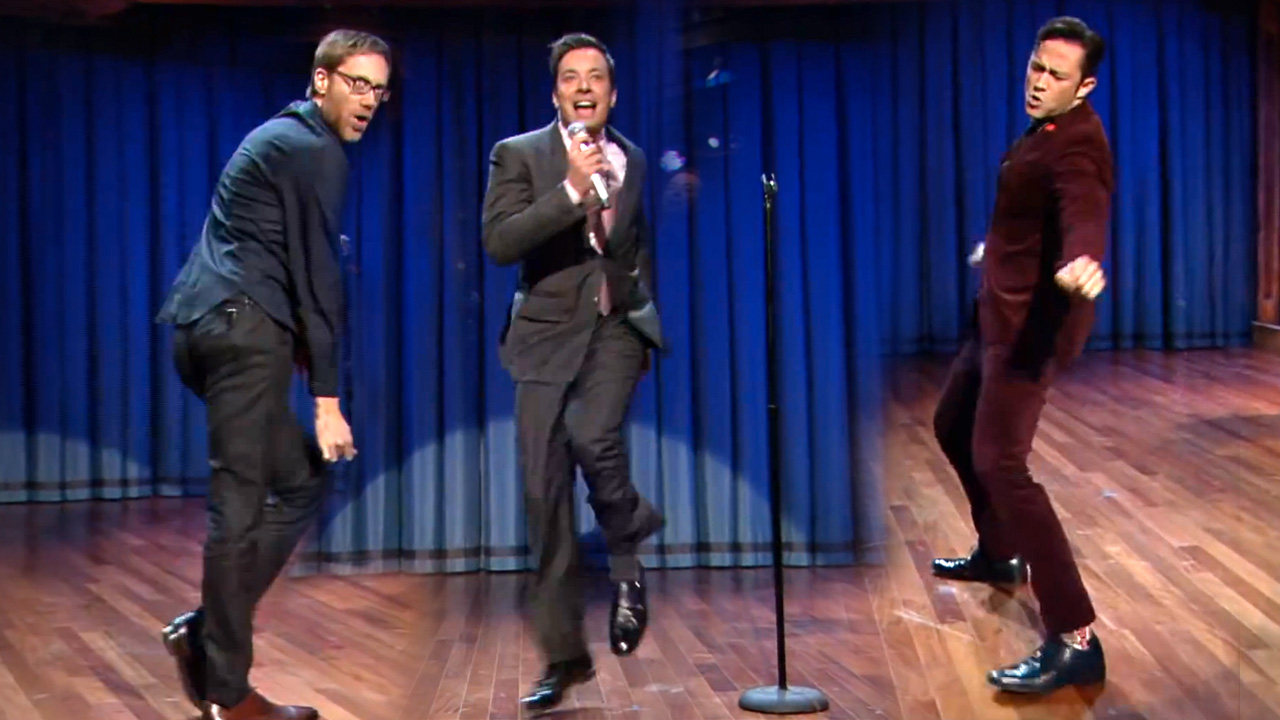
TOW 21 - Lip Sync Battles (Jimmy Fallon)

When you’re asked what you do for fun, you realize that the ways we entertain ourselves are so strange. Humor is the most entertaining way to take your mind of real world issues and complications, and while it may seem trivial, it can be critical to maintaining our mental health. One way I regulate my cerebral well-being is by watching Jimmy Fallon Lip Syncing Battles. In the lip sync battle with Joseph Gordon Levitt and Stephen Merchant, Jimmy Fallon and his guests use stylistic choices and serious tones to give their viewers a break from reality with entertainment. 
The way you define stylistic choices in writing is not be entirely the same as what you would call it in video, but nevertheless it is still effective. In this case, the three comedians choice of songs says a lot about their goal for the viewer. The songs chosen were tremendously popular at some point within the past thirty years, targeting a wide audience that will immediately connect with and enjoy the show. As they go onto lip sync, they are rousing nostalgia within the audience while poking fun at what we used to enjoy in a lighthearted fashion. With every inevitable laugh provoked, as heard in the studio audience, there is proof that these three are doing their job of entertaining.
These humorists use a mockingly serious tone which makes their work even more sidesplittingly hilarious. The fact that they chose their songs, they knew how ridiculous they would seem performing them, and they treated it as if they were serious musicians makes the performances infinitely better. How they perform their songs is almost ironic: seeing a tall, lanky man like Stephen Merchant swinging his hips to a fierce song by Beyoncé seems like the epitome of unexpected. Almost startling, the commitment Merchant displays is so unanticipated that it adds to the performance’s humor overall.

A person’s sense of humor is specific to him or her as an individual, but judging by the studio audience’s reaction, I can’t be the only person to crack up. Humor is the perfect way to fix a bad day or forget your problems, and in this sense entertainment is the best form of procrastination.